How it works Expert checks Supplier evidence Documented output Regulatory agents Food-safety alerts Audit readiness In-house capability Continuity Markets Knowledge Pricing FAQ See how FoodQA works Review one product with us
FoodQA · Label Intelligence

Your digital labelling expert

Grounded in supplier evidence and official sources.

For food manufacturers managing products, suppliers and labelling across multiple markets.

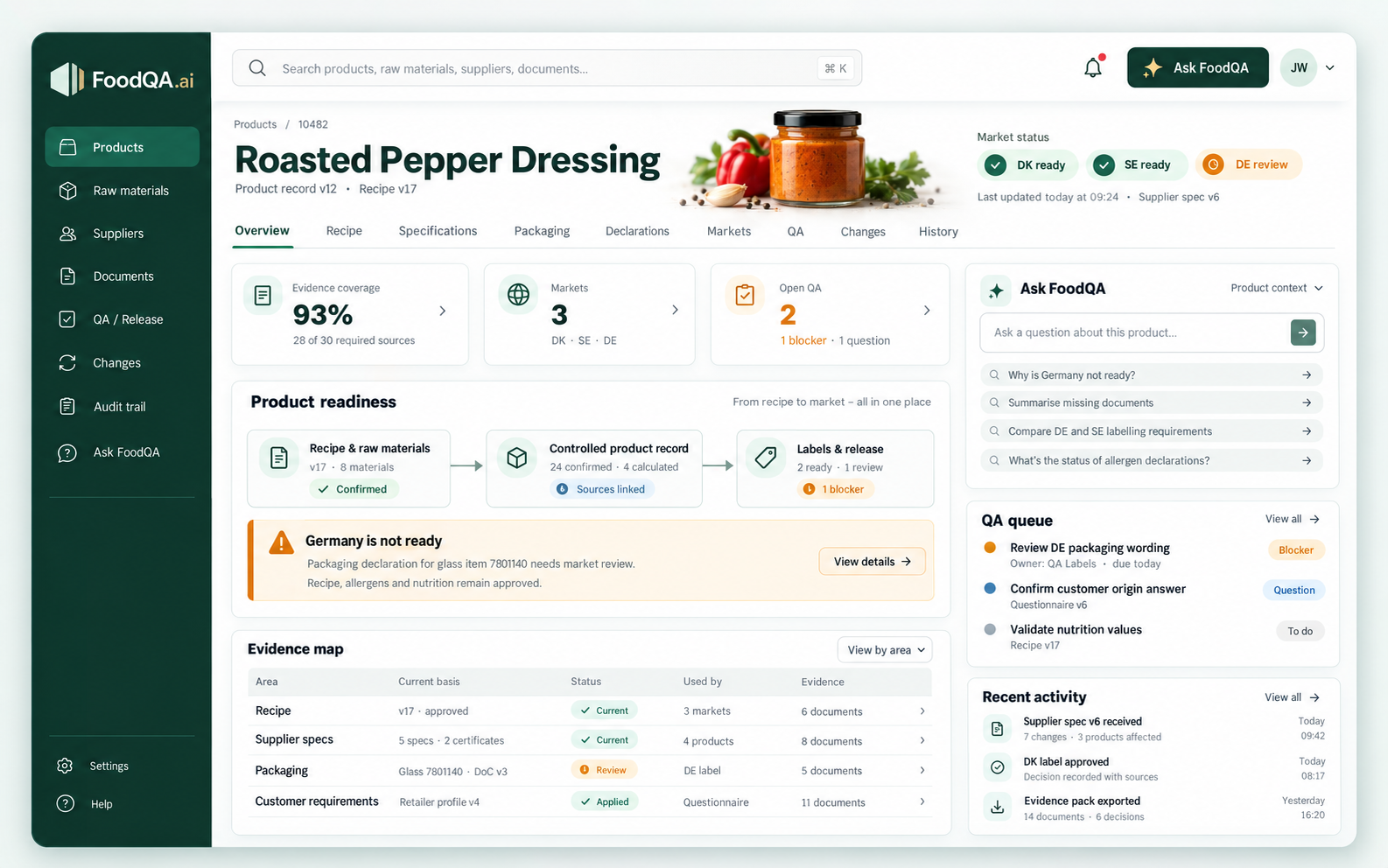
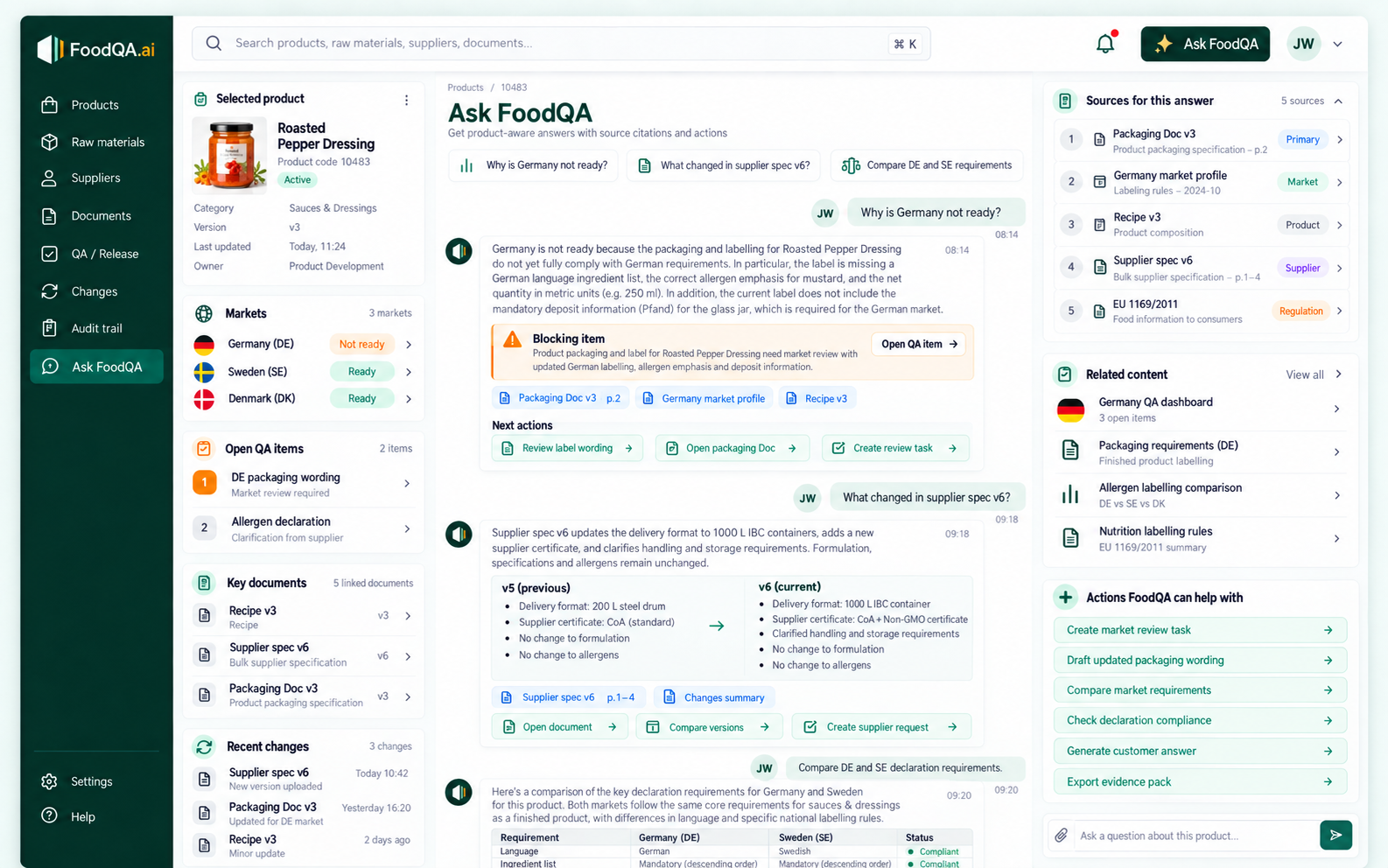
FoodQA connects recipes, supplier documents, ingredient structures, calculations and QA decisions in one guided workflow — helping food manufacturers prepare, review and maintain product labelling with a clear evidence trail.

Findings are connected to the relevant official legislation, guidance or authority source, so QA can open and review the basis behind the assessment. Regulatory agents keep watch on relevant official developments and food-safety alerts.

foodqa › label intelligence › Rye crispbread, sea salt
Proposal — requires company review
Proposed ingredient list — Sweden (sv)
RECIPE v4 · 6 SPECIFICATIONS · RULE PROFILE EU-2024.3 · RUN 08:41
Source
SPEC_rågmjöl_Lantmännen_v3.pdf, p. 1
Version
v3 · received 2026-02-11 · language: sv
Hash
sha256:4b91c2…e07a
Rule
Descending order by weight at time of use
Fullkornsrågmjöl. Enda ingrediens. Innehåller gluten (råg).Quotation from the supplier specification, section 2
Basis
Recipe v4, line 2 — added water 28.0 %
Calculation
Weight at time of use; baking loss not deducted
Note
Water lost during baking may change the declared order

FoodQA needs your baking loss to finalise the order of ingredients. One question is waiting.

Source
SPEC_surdeg_Nordic_Bake_v2.pdf, p. 2
Version
v2 · received 2026-01-28 · language: en
Hash
sha256:c07f18…9d33
Rule
Compound ingredient below 2 % of the finished product may be simplified — this one is above the threshold, so its components are listed
Rye sourdough. Composition: wholegrain rye flour 55 %, water 45 %.Quotation from the supplier specification, composition table
Source
SPEC_sesam_Baltic_Seeds_v1.pdf, p. 1
Emphasis
Sesame — emphasised in the ingredient list
Basis
Allergen named on the specification and present in the recipe
Hulled sesame seeds. Allergen: sesame. Packed on a line also handling mustard.Quotation from the supplier specification, allergen section

The specification mentions mustard on the same line. Decide whether a cross-contact statement applies.

Status
No specification found for this raw material
Effect
Sodium contribution cannot be documented; nutrition remains preliminary
Needed
Supplier specification with anti-caking agent status

Upload the salt specification to close this gap. Everything else is documented.

Select any line to see its basis

Less manual reconstruction

Recipes, specifications, calculations and decisions remain connected instead of being spread across emails, folders and spreadsheets.

More continuity

Colleagues can understand what a product record was built from and what was decided previously.

Earlier awareness of relevant change

Regulatory developments, supplier information and food-safety alerts can enter a structured QA review process.

How FoodQA works

One workflow, from raw material to documented output

FoodQA follows the same path a labelling specialist would. It keeps a record of every step — and asks where the record runs out.

01

Add the product foundation

Add or connect the recipe, BOM, existing label and relevant product information.

02

Connect supplier evidence

Link every relevant raw material to the correct supplier specification, document version and supporting evidence.

03

Unfold documented ingredient structures

FoodQA follows documented compound ingredients through their ingredient hierarchy and brings the documented contributions together.

04

Turn uncertainty into QA questions

Missing, ambiguous or conflicting information becomes a focused review item rather than an invented assumption.

05

Prepare the documented output

Ingredient information, supporting calculations, sources, open questions and QA decisions are brought together in a documented working foundation.

06

Keep the history

The product record retains what was used, what was missing and what was decided, so later review does not begin from zero.

Compound ingredients

Compound ingredients unfolded into a clear documented structure

A compound ingredient is an ingredient made of other ingredients — and those can be made of others again. FoodQA follows documented compositions through several levels and brings the ingredient contributions together.

Consider a seeded crispbread. The recipe lists a sourdough. The sourdough specification lists flour and water. The flour specification lists a single cereal. Three documents, three levels, one line on the finished label.

FoodQA follows that chain as far as the documents reach, brings the contributions together, and shows which document each level came from. Where a level is not documented, it says so rather than closing the gap with a guess.

Unfolding a hierarchy is not the same as producing a finished declaration. The structure is the input to your review, not a substitute for it.

Seeded crispbreadFinished product
SourdoughSupplier specification · v2
Wholegrain flourSupplier specification · v3
CerealSingle documented ingredient
WaterDocumented in the sourdough specification
SeedsSupplier specification · v1 · allergen noted
SaltNo specification connected — open QA question

Illustrative example. Fictional data.

Expert checks

One product — several expert checks

An ingredient list is the easy part. These are the questions that take an experienced colleague an afternoon, a spreadsheet and three phone calls.

01

One recipe does not always mean one market assessment

One formulation. Different national limits.

A water-based caffeinated drink containing 25 mg of inositol per 100 ml may fall within the relevant Danish general permission of 30 mg per 100 ml, while exceeding the German maximum of 20 mg per 100 ml for energy drinks.

FoodQA applies the selected market profile, checks the relevant product category and connects the finding directly to the official source.

This simplified example assumes that the product falls within the relevant category in each market. Notification, mutual-recognition and other market requirements may also require review.

DenmarkWithin permission — review
25 mg/100 ml against 30 mg/100 ml

General permission for the relevant categories of water-based non-alcoholic beverages, with and without added caffeine. §3(2)–(3): the quantity applies to the product’s total content of the substance, regardless of source or purpose of addition. §4: notification no later than first placing on the Danish market.

Open official source

BEK nr. 478 af 26/05/2026 · Annex 1, §§3–4 · in force · retrieved 2026-07-17

GermanyExceeds maximum — review
25 mg/100 ml against 20 mg/100 ml

§4 defines an energy drink as a caffeinated soft drink containing one or more substances listed in Anlage 8 Teil B. §5(2) requires the finished energy drink not to exceed those maxima. Anlage 8 Teil B: inositol 200 mg/l = 20 mg/100 ml.

Open official source

FrSaftErfrischGetrV · §4, §5(2), Anlage 8 Teil B · in force · retrieved 2026-07-17

02

Additive carry-over is not solved by spotting an E-number

A fictional compound fruit preparation contains potassium sorbate, E202. Finding the E-number is where the work starts, not where it ends.

FoodQA traces additives through compound ingredients, brings the documented contributions together and identifies the questions required for a carry-over assessment.

  • Find E202 inside the supplier composition
  • Follow it through the compound-ingredient hierarchy
  • Calculate the documented contribution from every source
  • Aggregate the contributions
  • Calculate the level against the documented finished-product basis
  • Identify the relevant food category and rule source
  • Ask whether E202 still has a technological function in the finished food
  • Preserve the QA decision and the evidence

FoodQA cannot infer technological function from an additive name, and an additive arriving through a raw material is not automatically exempt from declaration. Carry-over assessment needs source legality, final-food category, finished-product level, technological function, applicable exceptions, supplier evidence and a QA decision.

Potential carry-over — QA assessment required
Technological function in the finished food has not been documented
Finished-product concentration requires review
Supplier evidence is incomplete
Treat as a direct additive unless the carry-over conditions are documented

Illustrative states. Fictional product and supplier material.

03

Nutrition calculated against the finished yield, not the mixing bowl

For cooked and concentrated products, FoodQA calculates against the documented finished yield — not merely the ingredient weight before processing.

Total ingredient input1 000 kg
Documented finished yield after cooking800 kg
Total documented sugars in the input400 kg
400 / 800 × 10050 g sugars per 100 g

The version that looks right and is not

Using the 1 000 kg input weight40 g per 100 g

Ignores the documented evaporation loss. Ten grams per hundred, on a label.

What the record retains

  • Input batch weight and finished batch weight
  • Yield factor and the source of the yield value
  • Process version and the assumptions made
  • Nutrition-source versions
  • QA decision, optional laboratory result, manual override reason

Different nutrients need different treatment. FoodQA does not assume complete retention of vitamins, volatile components, drained components or process-sensitive nutrients — those require documented retention factors, laboratory analysis, supplier evidence, or an open QA item.

04

Brix, and what a refractometer does not prove

Annex V of Directive 2001/112/EC sets minimum Brix levels for reconstituted fruit juice and reconstituted fruit purée. Apple is 11.2 °Brix. Tomato is 5.0 °Brix.

These are minimum levels for reconstituted juice or purée. They are not universal fruit-percentage conversion factors.

Apple11.2 °Brix
Tomato5.0 °Brix

Annex V minimum Brix levels for reconstituted fruit juice and reconstituted fruit purée.

Simplified documented mass-balance example

Apple-juice concentrate100 kg
Documented concentrate Brix65 °Brix
Annex V minimum for reconstituted apple juice11.2 °Brix
100 × 65 / 11.2≈ 580 kg single-strength equivalent
Finished batch1 000 kg
580 / 1 000≈ 58 % single-strength equivalent

What the calculation must disclose

  • Final-product Brix alone does not prove fruit percentage
  • The product category must be confirmed
  • The documented concentrate Brix must be confirmed against a supplier specification or analysis
  • Other soluble solids must not be attributed to fruit
  • Values are expressed on a consistent mass basis
  • Density, yield and processing losses may also require consideration
  • Acid correction and product-specific rules may be relevant
  • QUID and nectar requirements need separate assessment

The calculation remains a documented QA review basis, not automatic legal approval. A refractometer reading of the finished product does not prove fruit percentage. Tomato works the same way — measured soluble solids, corrected for other added soluble solids, against the Annex V reference — never a universal raw-fruit formula.

Open official source

Directive 2001/112/EC · Annex V · Consolidated version: 14 June 2026 · Official EUR-Lex source · Retrieved: 17 July 2026

05

Specification freshness, on your policy — not ours

Your company defines when each type of specification should be reviewed.

FoodQA holds the interval you set and shows where each document stands against it. There is no universal renewal rule, and we do not invent one.

  • 6, 12, 24 or 36 months
  • Supplier expiry date
  • Document-type policy
  • Raw-material-risk policy
  • Review triggered by supplier, origin or formulation change

A one-year interval is a company policy example, not an IFS rule. IFS does not require every supplier specification to be renewed annually.

Review approaching
Review due
Review overdue
Supplier confirmation required
New version received
QA review completed
Situations

When FoodQA becomes valuable

Launching a new product

Bring recipe data, supplier documentation and QA questions together when preparing the product’s labelling foundation.

A supplier specification changes

Use the documented product record to understand which facts, calculations and labelling areas may require review.

An official development may affect the product

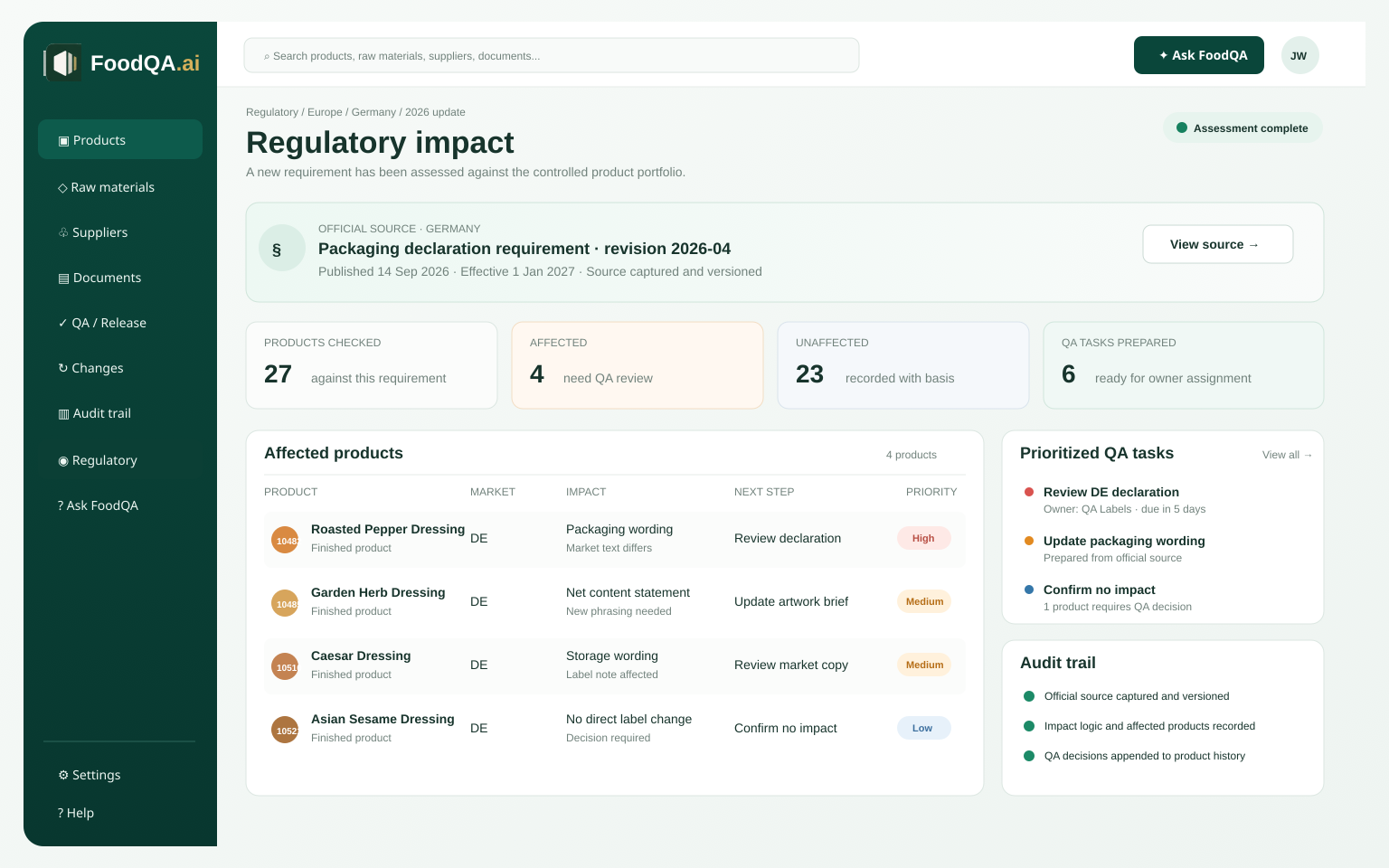
Regulatory agents and food-safety monitoring flag potentially relevant developments for structured QA review.

An experienced colleague is unavailable

A colleague can find the source documents, calculations, open questions and previous decisions without reconstructing the full history.

What you receive

A documented labelling draft — and an honest view of what still needs review

A working foundation, not a verdict: ingredient information and documented contributions, supplier references, allergen information from source documents, QUID review questions, additive information, nutritional source data, the calculations, the open QA items, the decisions and the evidence behind them.

run 2026-03-04 08:41 · rye crispbread, sea salt · sweden (sv)
Proposal — requires company review
Ingrediensersv · proposed

Fullkornsrågmjöl 62 %, vatten, rågsurdeg 6 % (fullkornsrågmjöl, vatten), sesamfrön 3 %, havssalt.

Compound ingredient shown with its components. Allergen emphasised. Order calculated at time of use.

Four of five raw materials are backed by a specification. Sea salt is still open.

Rule profile
EU-2024.3 · compound ingredients
Input
Rågsurdeg 6.0 % · components from SPEC_surdeg_Nordic_Bake_v2.pdf
Result
Components declared in brackets, in descending order
Method
Weight at time of use, descending
Engine
label-engine 1.8.2 · same input, same output
Open
Baking loss not yet supplied — order may change
Select any line to see its basis
Source
SPEC_sesam_Baltic_Seeds_v1.pdf, allergen section
Emphasis
Applied in the proposed ingredient list
Allergen: sesame.Quotation from the supplier specification
Sources
SPEC_rågmjöl_Lantmännen_v3.pdf · SPEC_surdeg_Nordic_Bake_v2.pdf
Handling
Named through the ingredient itself; no separate statement proposed
Source
SPEC_sesam_Baltic_Seeds_v1.pdf, packing note
FoodQA position
Cross-contact wording depends on your own risk assessment — not proposed automatically
Packed on a line also handling mustard.Quotation from the supplier specification
Checked
4 specifications with an additive section
Method
Each additive is read with its technological function, then tested for carry-over
Why it matters
If the salt contains an anti-caking agent, it may need to be declared with its function
Needed
Supplier specification for the sea salt
Proposed text
antioxidationsmedel (askorbinsyra)
Basis
Function first, then name or E-number — your house style decides which
Read more
Knowledge centre: additive name or E-number
Trigger
Product name in the brief: “Rye crispbread with sesame”
Available figure
3 % at time of use, from recipe v4
Open
Confirm whether the figure should be stated at time of use or in the finished product
Result
Rågsurdeg 6 % appears in the proposed ingredient list

FoodQA raises possible QUID questions from the words on your pack. Whether a quantity is required is your company’s decision.

Näringsvärde / 100 gpreliminary

Energi1 480 kJ / 350 kcal

Fett2.4 g

— varav mättat fett0.4 g

Kolhydrater58 g

— varav sockerarter1.1 g

Fiber15 g

Protein9.2 g

Salt? — awaiting specification

Method
Weighted sum per 100 g at time of use
Not applied
Baking loss · analytical verification
Engine
nutrition-engine 1.4.0
Options
Upload the specification, or send the product for analysis
Suggested
Sodium, moisture and fibre on the finished product

This is a preliminary nutrition profile calculated from specifications. It is not an analysis result.

Requested
2026-03-04 from Nordic Salt AB
Needed fields
Composition · additives · sodium per 100 g
Asked
“What is the weight loss during baking, as a percentage?”
Why
Water leaves the product; the declared order is calculated at time of use unless you decide otherwise
v1
Rye flour 60 % / water 40 % · received 2025-09-02
v2
Rye flour 55 % / water 45 % · received 2026-01-28
Used
v2 — most recent. You can override and FoodQA records the decision.
Relevance
Only if you intend to carry the mark — FoodQA does not apply it on your behalf
Depends on
Salt and fibre figures, which are still preliminary
Note
Customary names differ between Nordic markets even where the product is identical
Proposed
“Rugknækbrød med sesam” — for your review
Typical
Origin statements, analysis frequency, packaging data
Read more
Knowledge centre: legal requirements versus customer requirements

Everything above is collected into a Label Evidence Report — product and recipe versions, specification versions, sources, quotations, open questions, and the rule-profile and engine versions used for the run.

foodqa › impact analysis › RM-2271
Review required

From a raw-material change to potentially affected products and labels

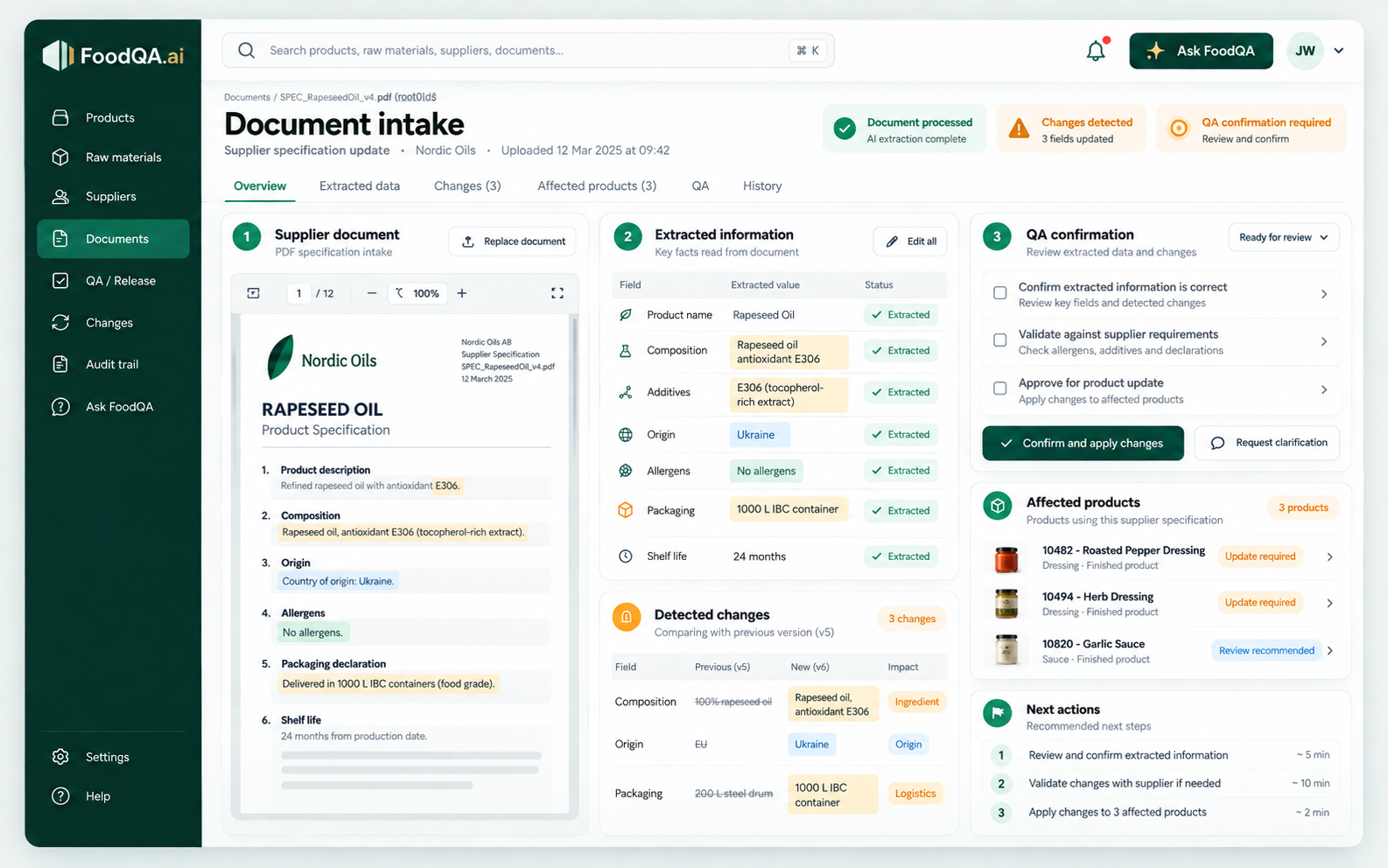
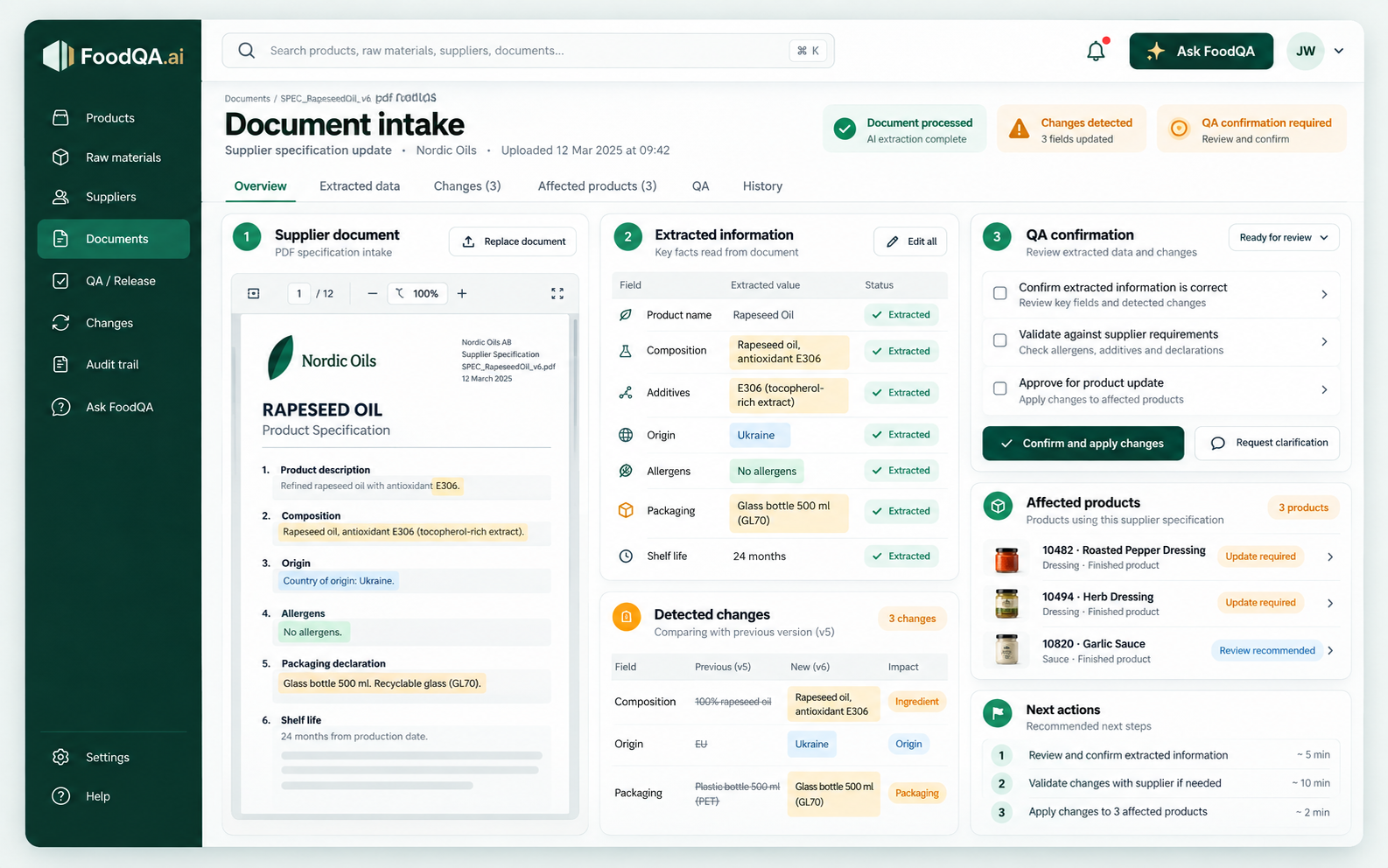
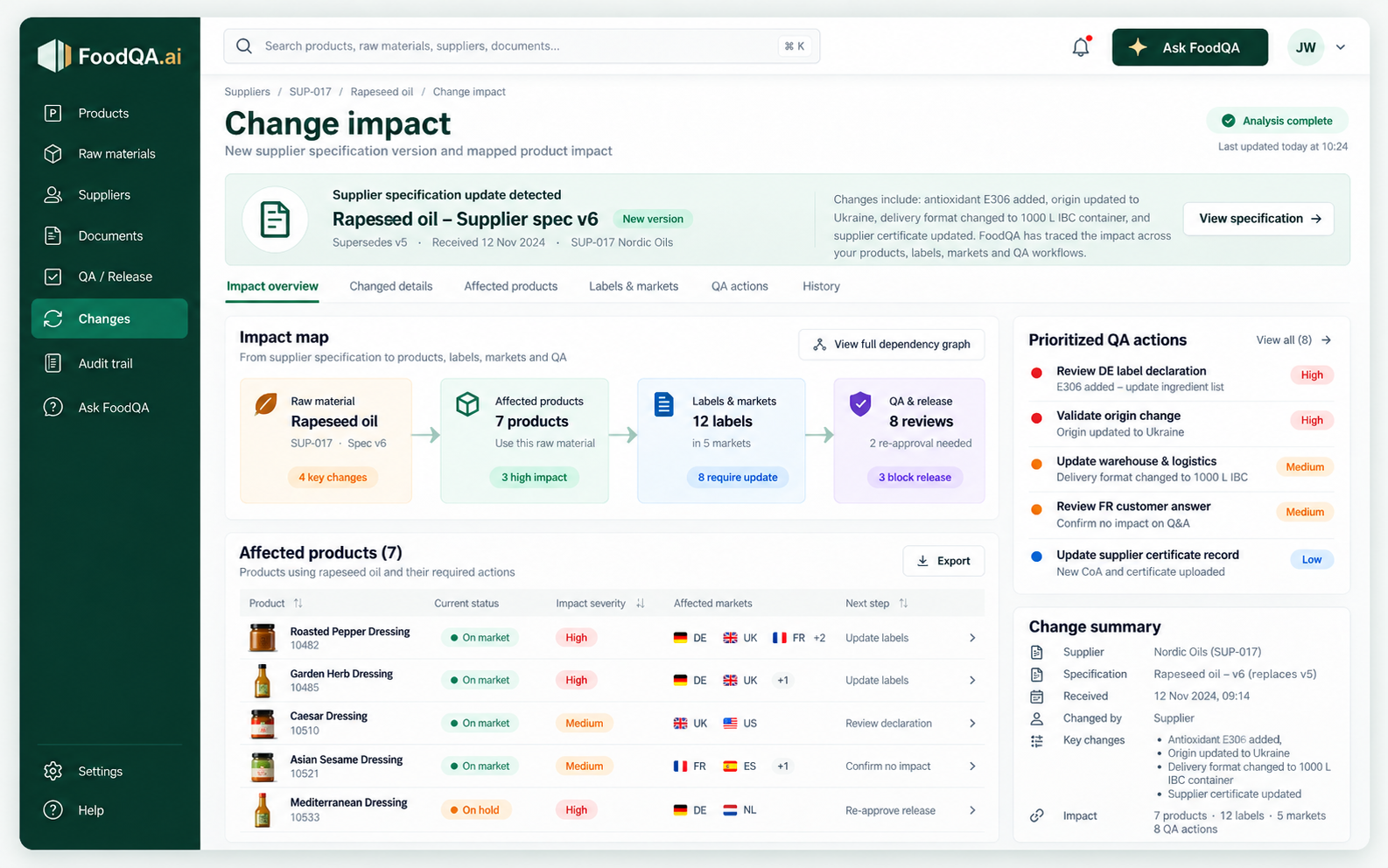
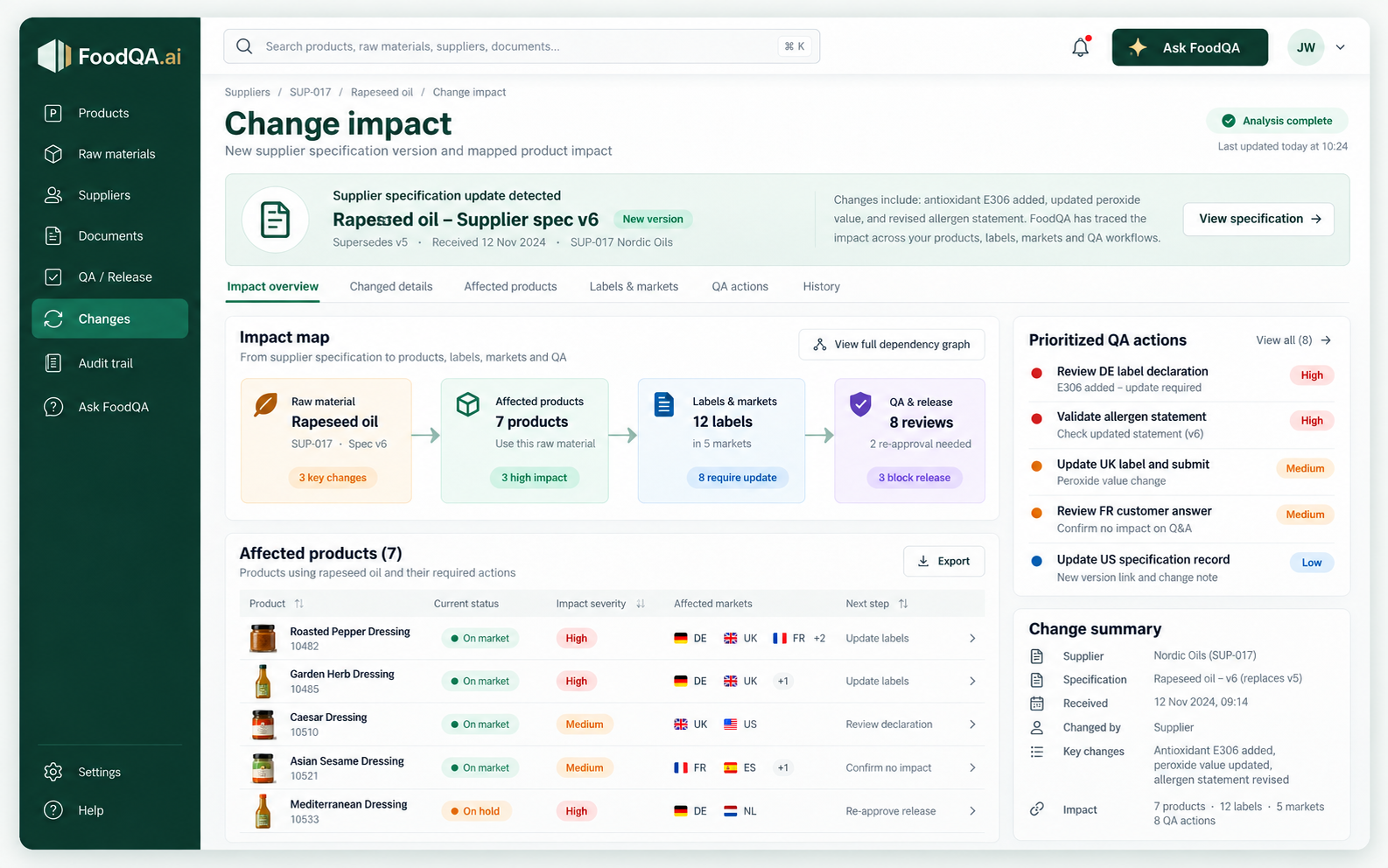
FoodQA also shows the other direction: when a supplier document changes — which finished products use the raw material, which label versions may require review, and which markets are involved.

Raw material · item number

RM-2271

Preservative blend

Supplier specification
Version 4
Specification status
Review required
Latest documented change
Updated additive composition
  1. Used in 6 finished products — including the finished product with item number FG-1042.
  2. 3 label versions potentially affected — each becomes an open review question and requires company review.
  3. Destination markets: Denmark, Sweden and Germany — the potentially affected label versions are spread across DK, SE and DE.

Synthetic demonstration data — invented item numbers and records. FoodQA presents the documented change and the potentially affected records; your QA team reviews and decides.

Label Evidence Report

The document you keep when the run is over

One file that holds the whole basis: which recipe and which specification versions were read, what was proposed, what was quoted, what stayed open, and which rule profile and engine produced the numbers. Written to be read by a colleague, a customer or an auditor — a year from now.

Join early access
Audit readiness

Built for audit-ready food-safety and quality documentation

FoodQA supports documented controls that are relevant to GFSI-recognised food safety certification programmes.

IFS states that labelling is among the five most frequently identified findings in IFS Food audits.

IFS Food News & Notifications — Managing labelling requirements

Three requirements worth knowing by number

4.3.2

The product-development procedure must ensure that labelling complies with current legislation in the destination countries and with customer requirements.

4.2.1.3KO

IFS Food v8 treats raw-material specification control as a KO requirement. Specifications must be documented, implemented, current, unambiguous and aligned with legal and defined customer requirements.

A D rating on a KO requirement prevents certification.

1.2.5

Senior management must maintain a system keeping the company informed of relevant legislation and scientific or technical developments.

FoodQA provides a structured way to monitor, retain and review relevant regulatory developments. Implementing FoodQA alone does not fulfil the requirement.

Open official source

IFS Food v8 · April 2023 · IFS Document Hub · requirements paraphrased · retrieved 2026-07-17

FoodQA workflow → example audit evidence

Supplier specification connected to raw materialApproved specification, version and review status
Recipe or BOM versionControlled product basis and change history
Label reviewReview record, sources, open points and QA decision
Regulatory findingOfficial source, status and impact review
RASFF potential matchRisk-screening evidence and documented follow-up
Corrective actionIssue, action, owner, evidence and effectiveness review

This is not a certificate and not an audit result. GFSI does not certify food manufacturers — manufacturers are audited against GFSI-recognised programmes such as IFS Food, BRCGS, FSSC 22000 or SQF. FoodQA provides structured evidence that can support the company’s implementation of relevant IFS Food requirements.

Capability

FoodQA turns repeated labelling projects into a consistent in-house capability

Traditional external label review often begins with reconstruction. The company first collects recipes, supplier specifications, previous artwork, market information and earlier decisions. The consultant then spends time understanding which information is complete and current before the specialist assessment can begin.

FoodQA keeps that foundation structured inside the company. Recipes, specification versions, calculations, official sources, open questions and QA decisions remain connected to the product.

External specialists can still be used for difficult interpretations, but their time can be focused on specialist decisions rather than repeatedly rebuilding the company’s own product information.

Use specialists for specialist decisions — not for repeatedly reconstructing your own product information.

Continuity

Less searching. Less reconstruction. Less key-person dependency.

In many food businesses, the detail of recipes, supplier specifications and labelling sits with very few people. That is not a failure of organisation. It is what happens when the work is intricate and the people who do it are good at it.

The difficulty comes later. When an experienced colleague is absent or has moved on, working out which documents, which versions and which decisions a label was actually built on can take significant time. The underlying information may be spread across inboxes, shared folders and private spreadsheets.

FoodQA brings recipe versions, specification references, open QA items and QA decisions together in one structured evidence trail. A colleague opening it sees the result, what it was built from, and what was decided along the way.

What that changes day to day

  • Reduces time spent searching for documentation
  • Makes previous decisions easier to understand
  • Reduces duplicated investigation
  • Gives colleagues a faster documented starting point
  • Reduces dependency on individual employees
  • Makes external specialist support more focused
  • Helps product knowledge remain with the company

A colleague can see the result, what it was built from, what remained unresolved, what was decided, who recorded the decision, and which source documents were used.

Labelling knowledge should belong to the company — not only to the person who created it.

When an experienced colleague is absent or leaves, the documented basis remains available to the company.

Regulatory agents

Regulatory intelligence that keeps watching

Food regulations do not stand still after a label has been prepared. A rule adopted this month may apply in two years; a proposal may never apply at all. Somebody has to keep track of the difference.

FoodQA uses specialised regulatory agents designed to monitor relevant official European and national sources — and to bring what they find into the same documented QA workflow as the rest of your product record.

What the agents watch for

  • Adopted legislation and amendments
  • Legislative proposals and public consultations
  • Official guidance and authority interpretations
  • Transitional periods and future application dates
  • Repealed or superseded requirements

What is kept with each development

Official source
Where it was published
Publication date
When it appeared
Status
Proposal · consultation · adopted · published · applicable from · repealed · superseded
Affected market
Which of your markets it touches
Regulatory subject
What area it concerns
Future effective date
Where one is available

A proposal is not law. A consultation is not law. The agents record status precisely, because the difference between adopted and proposed is the difference between a deadline and a rumour.

Monitoring European sourcesOfficial EU publications and the developments that reach every market at once.
Monitoring national sourcesThe national layer that sits on top — where the terminology and the detail live.
Classifying statusProposal, consultation, adopted, applicable from, repealed, superseded.
Identifying relevanceWhich markets and which regulatory subjects a development actually concerns.
Tracking effective datesIncluding the ones years out, which are the easiest to forget.
Preparing change summariesA documented summary rather than a link to forty pages of legal text.
Flagging product recordsConnecting the development to the product records that may require QA review.

FoodQA monitors the change. Your QA team retains the decision.

Food-safety alerts

Food-safety alerts matched to your own materials and products

The point is not to show you every alert. Nobody reads every alert. The point is to filter the wider alert landscape through your own materials, origins, markets and products.

FoodQA’s agents are designed to monitor relevant official food-safety alerts, including relevant notifications from RASFF — the EU Rapid Alert System for Food and Feed — and other official recall or warning sources.

The agents compare an alert against your documented profile, where that information is available:

  • Commodity or ingredient
  • Country of origin
  • Supplier
  • Product category
  • Hazard — pesticide, contaminant, allergen, microbiological, food-contact material

Hypothetical example

For example, an official alert concerning Salmonella in sesame seeds from a specified country of origin could be matched against products that use the same documented commodity and origin.

A match indicates possible relevance only. It does not prove that the same supplier is involved. It does not prove that the same batch is affected. It does not prove that your product is unsafe. QA must verify suppliers, batches, certificates and traceability evidence.

01Official alert detected
02Commodity, origin and hazard classified
03Compared with documented company materials and products
04Potential matches flagged
05QA reviews suppliers, batches and evidence
06Decision and follow-up recorded

Monitoring does not replace supplier contact, traceability checks, certificates of analysis, laboratory testing or QA review — and FoodQA does not start a recall or withdrawal. It puts the alert in front of the people who decide.

Getting started

Start with one product

Not a platform migration. One representative product, the documents you already have, and a conversation about what came out.

1

Select one representative product

Choose a product with a recipe, existing label and relevant supplier documentation.

2

Share the available material

Provide the recipe or BOM, current label and supplier specifications. You can start without a complete ERP integration.

3

Structure the evidence

FoodQA brings the material together and identifies missing, unclear or conflicting information.

4

Review with QA

The documented foundation and open questions are reviewed with your QA team.

5

Decide the next scope

Based on the first product, decide whether to expand to more products, markets or monitoring areas.

About

Built on practical experience from food production

FoodQA was founded by Jens Wilsby, who works day to day as managing director and co-owner of a Danish food company, where he holds overall responsibility for quality and food safety.

Through the work of helping build and maintain the company’s quality management system and reach IFS Food Higher Level, it became clear how time-consuming and error-prone the work with recipes, supplier specifications, document versions and food labelling can be.

A change in a single supplier specification can affect several products, ingredient lists, allergens, additives, nutritional calculations and labels. At the same time, much of this is still handled manually, or with expensive external advice.

FoodQA was developed as an independent project to structure that work, catch changes earlier, and make it easier to produce and maintain a documented labelling basis.

The aim is to save food companies time, reduce the risk of errors, and make it easier to use professional advice where it creates the most value.

Built by a food manufacturer — for food manufacturers.

FoodQA · Label Intelligence
Jens Wilsby

Markets

Denmark, Sweden and Germany

FoodQA follows the regulatory sources and terminology relevant to the markets selected for the company. English is a website language, not a regulatory market.

Denmark

Danish terminology, Danish customary product names, and the national requirements that sit on top of the EU core.

Label output language: Danish (da)
Sweden

Swedish terminology and the national requirements that sit on top of the EU core.

Label output language: Swedish (sv)
Germany

German terminology and the national requirements that sit on top of the EU core.

Label output language: German (de)
Knowledge centre

Written for people who make food — not only people who read regulations all day

10 articles · free to read

Pricing concept

Scope FoodQA around your product portfolio

Every food manufacturer arrives with a different portfolio, a different pile of supplier documents and a different set of markets. A price list that ignores that would be a fiction. So we start with scope.

Scope and pricing agreed per company

What scope depends on

  • Number of products
  • Number of markets
  • Number and complexity of supplier documents
  • Regulatory-monitoring scope
  • Alert-monitoring scope
  • Integration requirements
  • Onboarding effort
  • Portfolio size

Let us work out your scope

Bring one product and the supplier documents you already have. Half an hour is usually enough to see what can be documented, what needs clarification, and what the work would actually involve for your portfolio.

Discuss your first product

Opens your mail app. No form, no tracking, no waiting list.

FAQ

The questions we actually get asked

Does FoodQA legally approve labels?

No. FoodQA structures evidence, calculations and review points. Your QA team retains the final decision.

Can we begin without ERP integration?

Yes. The initial workflow can begin with available recipes, BOM exports, spreadsheets, labels and supplier documents.

What happens when supplier information is incomplete?

FoodQA identifies the missing or conflicting information and creates a focused QA review point rather than silently guessing.

Which markets are initially relevant?

The initial regulatory-market focus is Denmark, Sweden and Germany. English is a website language, not an additional regulatory market.

Does FoodQA monitor legislation?

FoodQA’s regulatory agents are designed to monitor relevant official developments, including adopted legislation, proposals, guidance and future effective dates.

Does a RASFF match mean our product is affected?

No. A potential match indicates that the commodity, origin or hazard may be relevant. Suppliers, batches, traceability and evidence must still be verified.

Does FoodQA replace laboratory analysis or specialist advice?

No. Laboratory analysis or specialist advice may still be required depending on the product and the available evidence.

How do we begin?

Start with one representative product, its recipe, current label and available supplier documentation.

How is confidential product information handled?

Recipes and supplier documentation are treated as controlled company information, kept per company and not pooled with other customers’ material. Hosting and retention details are agreed in writing before any real document is shared.

Get started

Review one product with us

Bring one product, its recipe and supplier documentation. We will review how a documented FoodQA workflow could be structured around it.

FoodQA is currently onboarding selected food manufacturers through an early-access programme. Product scope is introduced progressively as part of the rollout.

6Steps per run
1Report per run
0Results without a source
Early access

Write to Jens

We onboard a small number of companies at a time, so early access starts with a conversation rather than a queue. Send an email and you will get a reply from a person.

Worth including

  • Your company and what you make
  • The markets and label languages you need
  • One product you would like to try first
  • A labelling problem that keeps coming back
Email jens@foodqa.ai

Opens your mail app with the subject already filled in.
No form, no tracking, no waiting list.